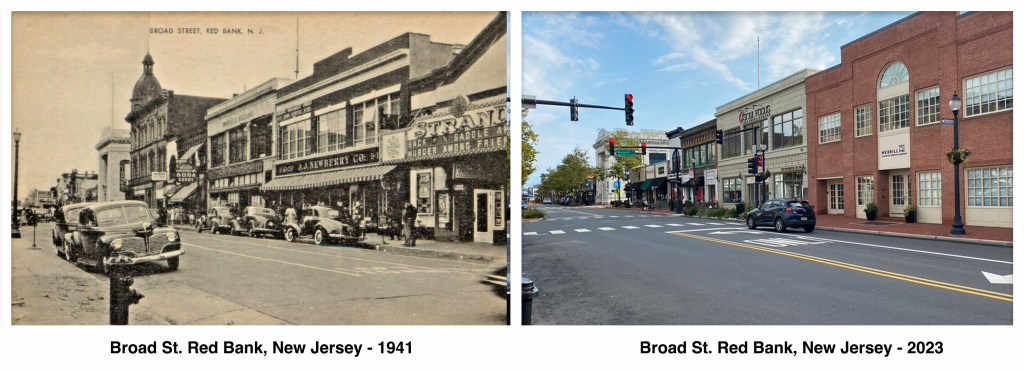
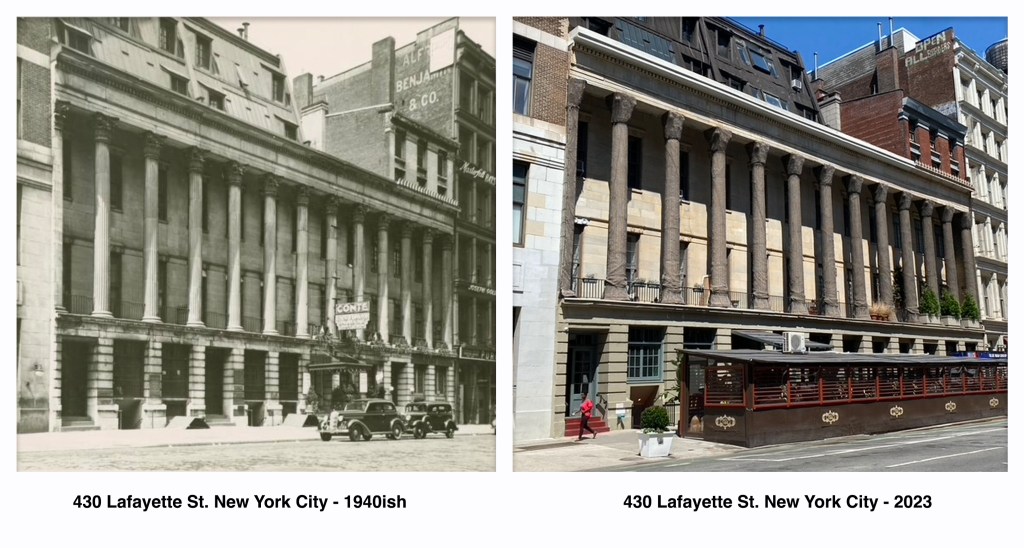
I was able to date this photo from the movie marquee in the original postcard. Murder Among Friends was a 1941 American mystery film directed by Ray McCarey and written by John Larkin. The film stars Marjorie Weaver, John Hubbard, Cobina Wright, Mona Barrie, Douglass Dumbrille, and Sidney Blackmer. The film was released on February 28, 1941, by 20th Century Fox.
I stumbled upon this one accidentally. I was walking through Brooklyn with my family and this building caught my eye. The once clean and beautiful little North Side Bank is now a hip little surf shop. https://pilgrimsurfsupply.com/
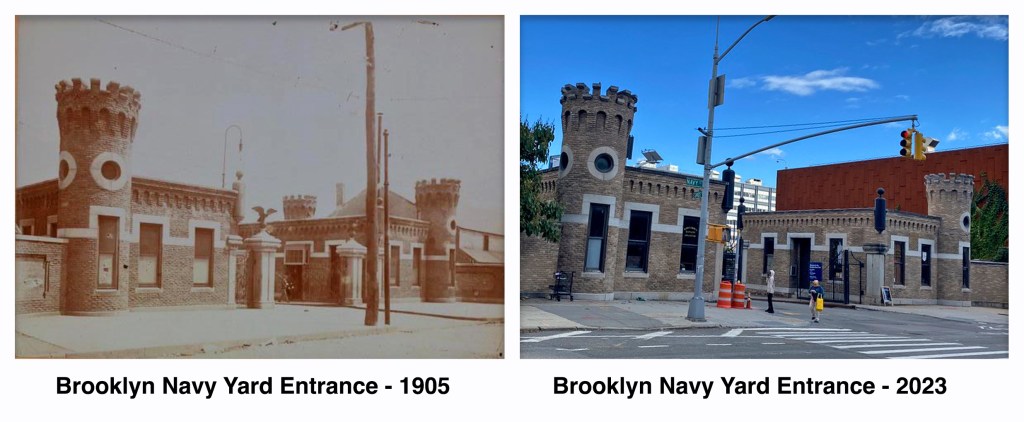
Brooklyn Navy Yard is changing fast but some things still remain.
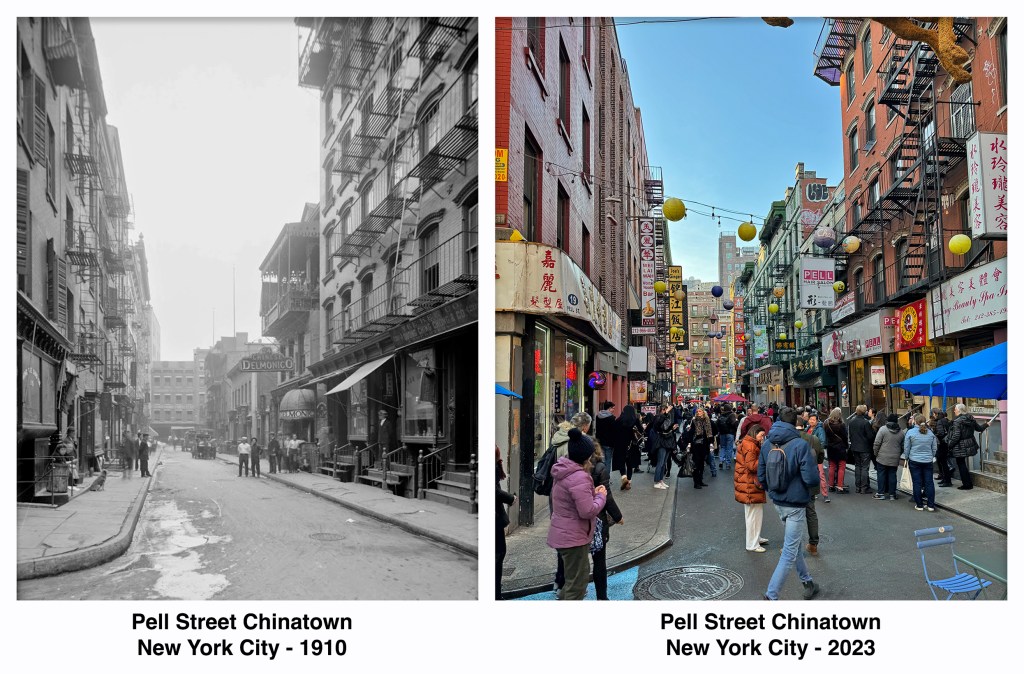
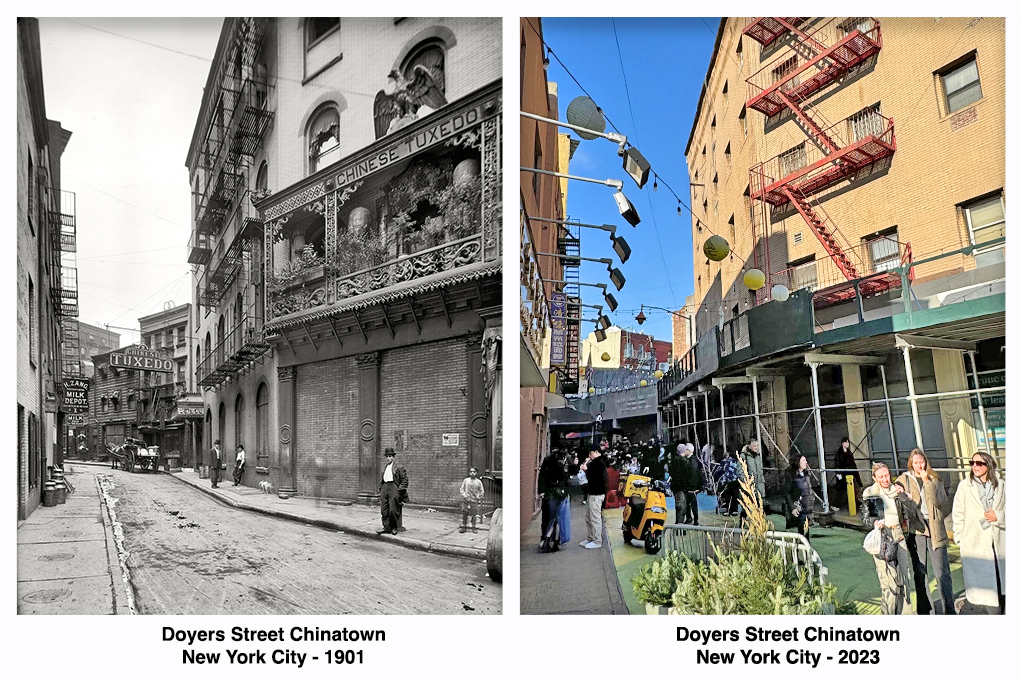
Take a look at these before and after photos captured during a recent Open House New York tour, expertly led by the delightful Taylor Zhou. The tour covered a range of fascinating topics, but one of the most interesting and often overlooked was the history and impact of the Chinese Exclusion Laws passed in 1882. These laws had a significant impact, dramatically limiting immigration from China and virtually eliminating any Chinese women from coming to the US. If you’re keen on learning more about this critical issue, be sure to check out the 1882 Foundation at (https://1882foundation.org/about-the-foundation/).
This post is special to me, not only because this is an amazing part of the city with incredibly preserved pieces of New York City’s architecture and history but also because this is the first independent before-and-after photo contribution from my son Deklyn Gardner, a first-year student at Parsons.
The before photo is from the book, Ottman & Company: Meatpacking District Pioneers. Jacquelyn Ottman, fifth-generation Ottman family member, unpacks the Meatpacking District and its most storied meat purveyor, Ottman & Company.
This blog has no affiliation with the book or author.
Sometimes what is no longer there can be just as interesting as what remains. This happens a lot. I’ll track down an interesting image, find the location, and learn that the building no longer exists. It can be a little sad and sometimes a little haunting. I wonder how much longer the building on the right will remain?
The image above is a good example of how lens distortion can make it difficult to get a perfect before and after match. Whatever lens the photographer used in the original image created a perspective distortion making it look different even though the angle and distance of the two shots were the same.
The American Hotel was built in 1898–1900 by W.Kromhout and H.G. Jansen in the Berlage style. In 1927–1928 an expansion was realised from a design by the architect G.J. Rutgers in collaboration with K. Bakker in 1927–1928. Both the expansion and the café are National Heritage sites.
It is now call the Hard Rock Hotel Amsterdam American, also known for its Café Américain, on Leidseplein in Amsterdam, Netherlands, is a hotel and café restaurant with a Jugendstilreading room.
The 1945 shooting on Dam squaretook place during the liberation of Amsterdam on 7 May 1945, in the last days of World War II in Europe. Germansoldiers fired machine guns into a large crowd gathered on Dam squareto celebrate the end of the war, killing over 30 people.
Leidseplein is a buzzing nightlife hub centered around Leidseplein Square, where crowds are entertained by street performers and the surrounding bars and restaurants are always busy. Local theaters, such as the neo-Renaissance Stadsschouwburg, present classical music, stand-up comedy andmusicals, while iconic concert venues Paradiso and Melkweg host DJ gigs and concerts by indie and big-name bands.
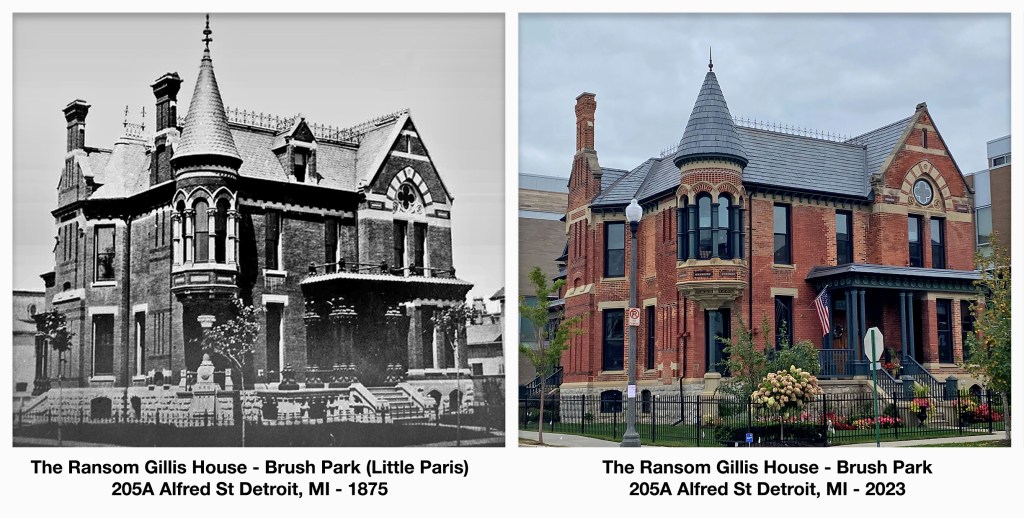
Burton Historical Collection, Detroit Public Library
Ransom Gillis House on the corner of John R and Alfred Street in downtown Detroit. Unoccupied since the late 1960s, the Ransom Gillis mansion was ready to crumble when the Rehab Addict team came to the rescue. See how this Detroit landmark was transformed from top to bottom.
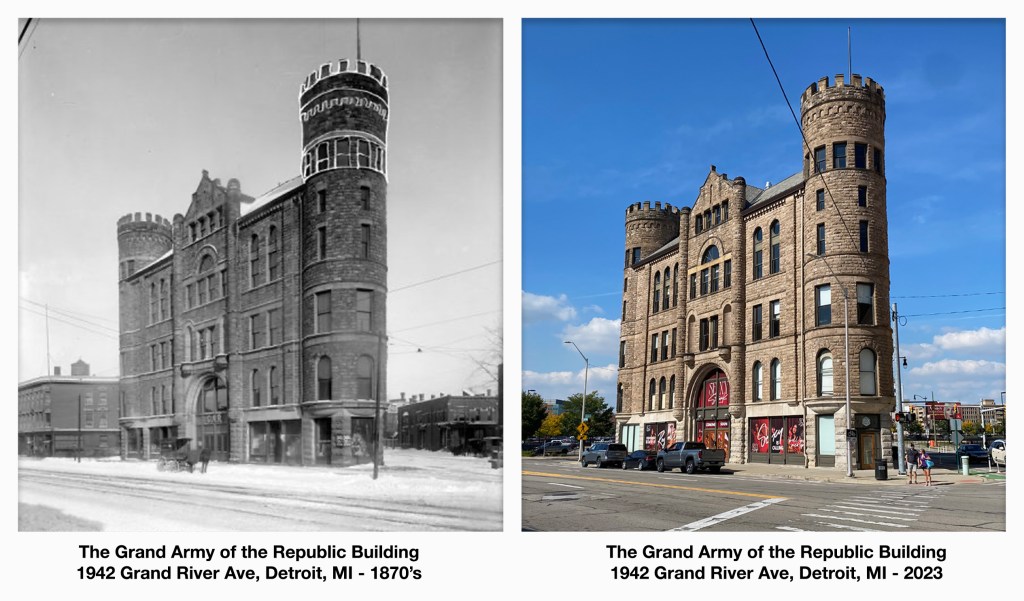
The GAR Building was designed by architect Julius Hess, and constructed at 1942 West Grand River and Cass as an appropriate structure for meetings and other GAR related activities. The cost was split between the Grand Army of the Republic (who paid $6000 of the cost) and the city of Detroit (who paid the remainder of the $44,000 total cost). Construction commenced in 1897 on the five-story building.
This was originally the home of the Conductors Protective Association, a UAW of sorts for train employees. Hence, it was built across Michigan Avenue from Michigan Central Station. It was designed by Alvin E. Harley, who is better known for his residential designs. Check out the vision of this building’s possible future: https://www.loopnet.com/Listing/2411-14th-St-Detroit-MI/17329774/
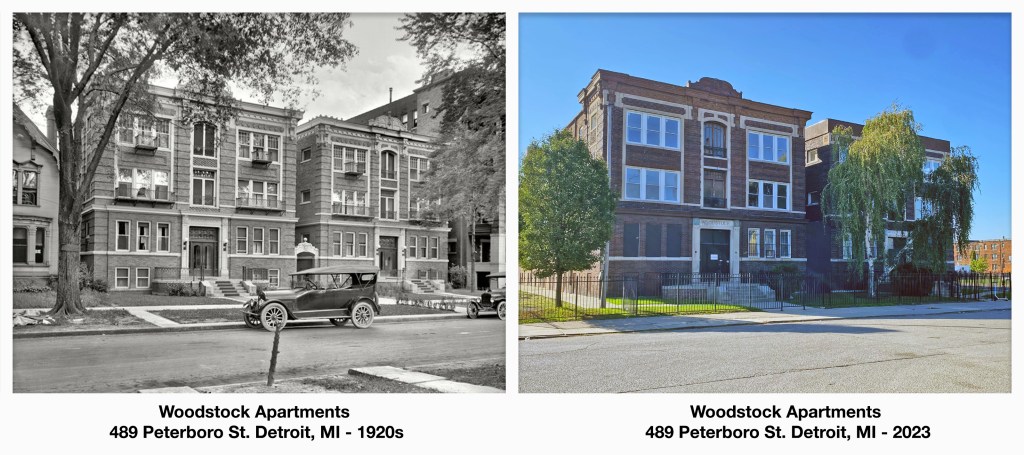
The Woodstock Apartments are located at 475 Peterboro and were built in 1914. The Beaux-Arts style buildings have 80 apartments in the center of Detroit’s Cass Corridor. During the 1920s, Peterboro Street was home to 12 similar apartment buildings. Today the Woodstock Apartments are the only two such remaining buildings.
Great to be back out in the world again! Here are some before and after finds from Brooklyn and Manhattan this past Fall.
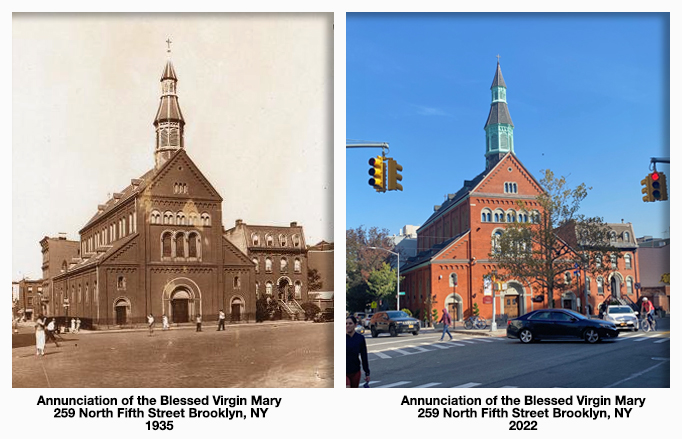
The Roman Catholic parish of the Annunciation of the Blessed Virgin Mary, located in the Williamsburg area of Brooklyn, was established in 1863. F.J. Berlenbach, Jr., designed the Lombardian Romanesque basilica in 1870.
The Austin organ now in the Church of the Annunciation was originally built in 1912 for St. Peter’s Episcopal Church, Morristown, N.J. In 1930, St. Peter’s installed a new Skinner organ (Op. 836), and the Austin organ was acquired by Annunciation Church.
Wiesbaden Hauptbahnhof is a railway station for the city of Wiesbaden, the state capital of the German state of Hesse. It is a terminal station at the southern edge of the city centre and is used by more than 40,000 travelers each day, so it is the second largest station in Hesse after Frankfurt Hauptbahnhof.
The Deportation of the Jews of Wiesbaden
In March, May and June of 1942 some 500 Jews were deported from Wiesbaden, among them several rabbis. The deportees were led in groups down the city’s streets toward the local train station, loaded onto cattle cars, and sent to the Lublin district in Poland. After a layover in Piaski these Jews were sent to Sobibor, Belzec and Majdanek, where they were murdered.
On the 11th of June 1942, more than 600 Jews from the district of Wiesbaden, mostly from the city itself, were loaded onto cattle cars and deported to Frankfurt. From Frankfurt, these Jews were deported together with 600 Jews from the Frankfurt community to the district of Lublin. Nearly two hundred of them were deported directly to Majdanek, and the rest were sent to Sobibor following a two-day stop in Izbicia. It is not known of anyone who survived this transport.
By the time of the next deportation, some 40 Jews in Wiesbaden had committed suicide.
On the 27th of August 1942, the last public prayer service was held in Wiesbaden. From the 27th to the 29th of August 1942, six hundred Jews, many of them elderly and weak, were collected in the courtyard of the Orthodox synagogue. The Jews were photographed at the collection point in front of the Orthodox synagogue, during their registration at the police station, and when they boarded the deportation train at the city’s train station. On the 29th of August the Jews of Wiesbaden were deported to Frankfurt, where another 600 local Jews boarded the train. On the 1st of September the train left Frankfurt, and it arrived in Theresienstadt the following day. The Jews on this transport were primarily elderly or sick people, as well as Jews who had been decorated or injured in World War I, and their families. Later, these Jews were deported from Theresienstadt to Auschwitz. Thirty-two Jews from this deportation survived the war.
The responsibility for liquidating the community’s assets was placed on Berthold Gutmann, a lawyer who was sent on the September 1st transport to Theresienstadt together with his son. The head of the Jewish community, Moritz Maxheimer, was also deported and was murdered in Auschwitz a month later. The secretary of the Jewish community, Arthur Strauss, was deported in March 1943 together with his wife Anna to Theresienstadt, from where he was deported in October 1944 to Auschwitz. Thirteen Jewish doctors from Wiesbaden were deported and perished as well, most of them in Theresienstadt.
In December 1942, fewer than 200 residents of Jewish origin remained in Wiesbaden; most of them were “half” or “quarter” Jews, or Jews married to Aryans who had been defined by the regime as having extra privileges. In 1943 these Jews were added to the Frankfurt community. Twenty-five of them were deported to Theresienstadt in February of 1945.
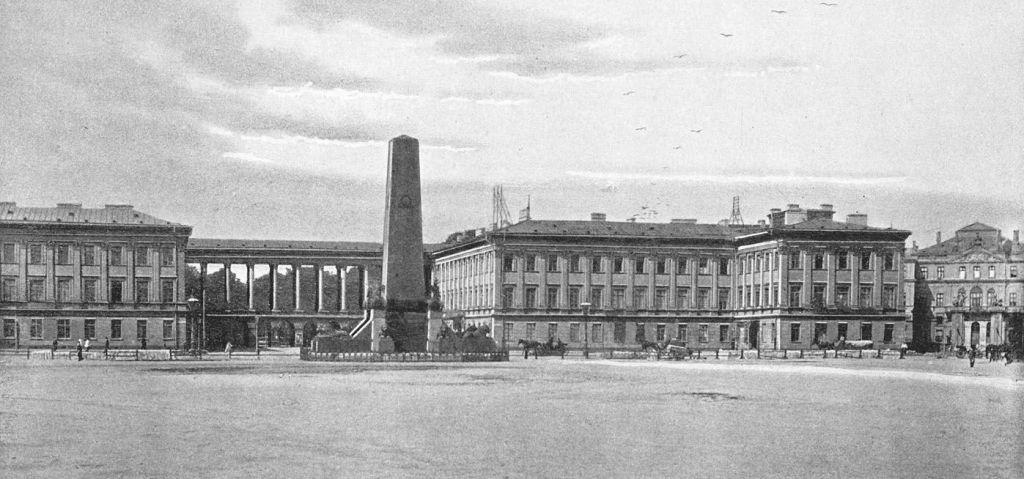
The Tomb of the Unknown Soldier (Polish: Grób Nieznanego Żołnierza) is a monument in Warsaw, Poland, dedicated to the unknown soldiers who have given their lives for Poland. It is one of many such national tombs of unknowns that were erected after World War I, and the most important such monument in Poland.[1]
The monument, located at Piłsudski Square, is the only surviving part of the Saxon Palace that occupied the spot until World War II. Since 2 November 1925 the tomb houses the unidentified body of a young soldier who fell during the Defence of Lwów. Since then, earth from numerous battlefields where Polish soldiers have fought has been added to the urns housed in the surviving pillars of the Saxon Palace.
During the 1939 invasion of Poland, the building was slightly damaged by German aerial bombing, but it was quickly rebuilt and seized by the German authorities. After the Warsaw Uprising, in December 1944, the palace was completely demolished by the Wehrmacht. Only part of the central colonnade, sheltering the Tomb, was preserved.
After the war, in late 1945, reconstruction began. Only a small part of the palace, containing the Tomb, was restored by Henryk Grunwald. On 8 May 1946 it was opened to the public. Soil from 24 additional battlegrounds was added to the urns, as well as more tablets with names of battles in which Poles had fought in World War II. However, the communist authorities erased all trace of the Polish–Soviet War of 1920, and only a few of the Polish Armed Forces’ battles in the West were included. This was corrected in 1990, after Poland had regained its political autonomy.
Here are a couple of photos of Saxon Square before the German destruction of the city.
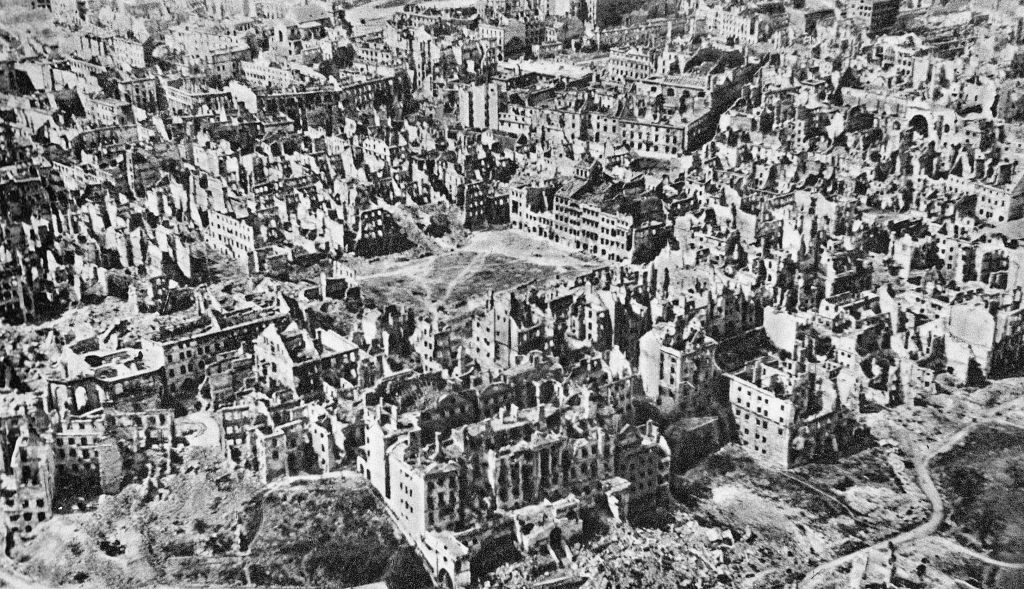
An aerial view of the city after the war the Germans destroyed. The losses to Warsaw’s urban architecture at the beginning of 1945 were estimated at around 84%, with industrial infrastructure and historic monuments destroyed at 90% and residential buildings at 72%. After the Warsaw Uprising, a city which was home to over 1 million people before the war was almost deserted, with only a few thousand people living in its ruins.
The Warsaw Uprising was a major World War II operation, in the summer of 1944, by the Polish underground resistance, led by the Home Army, to liberate Warsaw from German occupation. The uprising was timed to coincide with the retreat of the German forces from Poland ahead of the Soviet advance.
Although the exact number of casualties is unknown, it is estimated that about 16,000 members of the Polish resistance were killed and about 6,000 badly wounded. In addition, between 150,000 and 200,000 Polish civilians died, mostly from mass executions. Jews being harboured by Poles were exposed by German house-to-house clearances and mass evictions of entire neighbourhoods. German casualties totalled over 2,000 to 17,000 soldiers killed and missing.[11] During the urban combat, approximately 25% of Warsaw’s buildings were destroyed. Following the surrender of Polish forces, German troops systematically levelled another 35% of the city block by block. Together with earlier damage suffered in the 1939 invasion of Poland and the Warsaw Ghetto Uprising in 1943, over 85% of the city was destroyed by January 1945 when the course of the events in the Eastern Front forced the Germans to abandon the city.
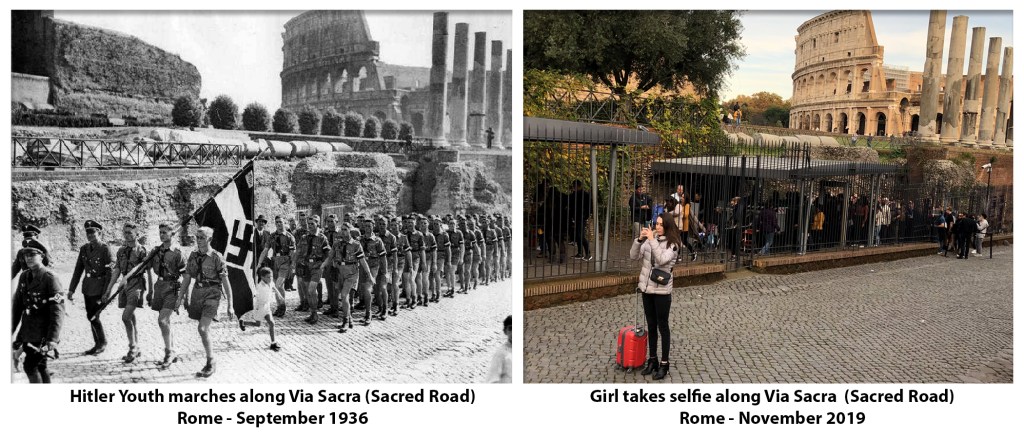
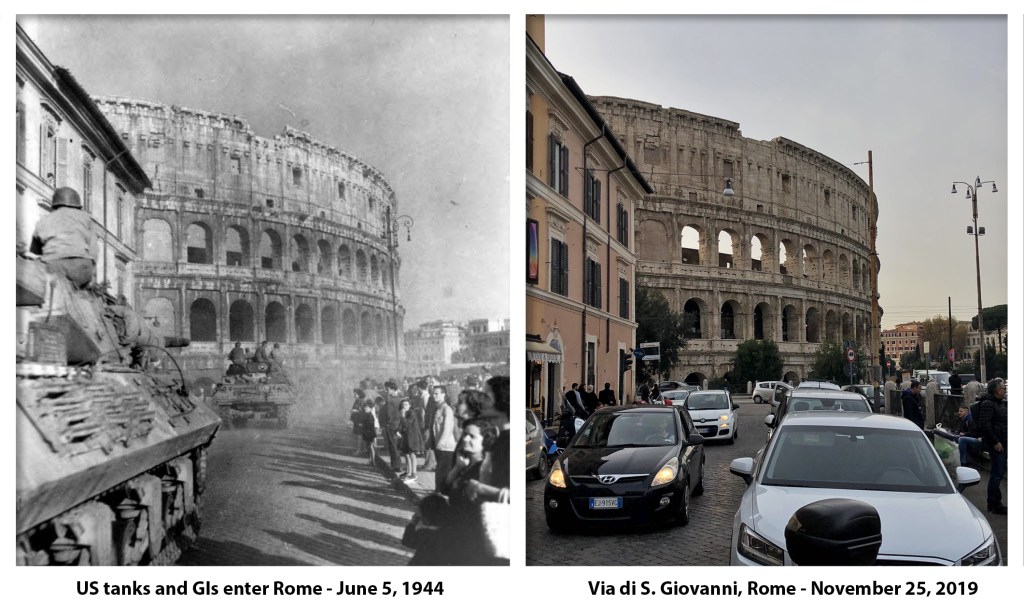
Long before their occupation of Rome and eventual defeat, the Nazis had a strong presence in Italy. After the Italian surrender and 9 month Nazi occupation, US tanks and troops pour into the Roman capital in June of 1944 at the same time allied troops were storming the beaches in Normandy far to the north.
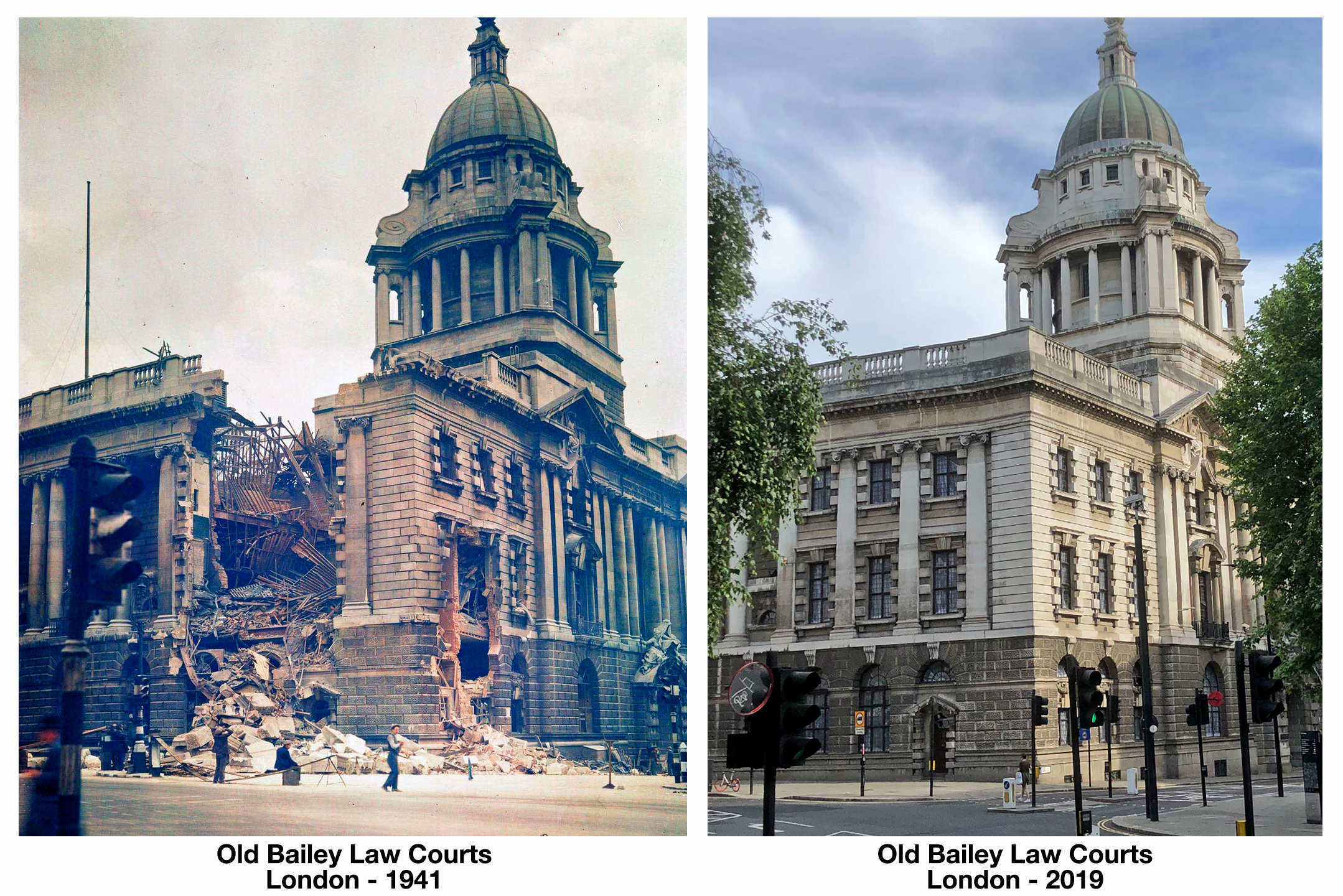
The Blitz was a German bombing campaign against Britain in 1940 and 1941, during the Second World War. The term was first used by the British press and is the German word for ‘lightning’.[4]
The Germans conducted mass air attacks against industrial targets, towns, and cities, beginning with raids on London towards the end of the Battle of Britain in 1940, a battle for daylight air superiority between the Luftwaffe and the Royal Air Force over the United Kingdom. By September 1940, the Luftwaffe had failed and the German air fleets (Luftflotten) were ordered to attack London, to draw RAF Fighter Command into a battle of annihilation.[5][6]Adolf Hitlerand ReichsmarschallHermann Göring, commander-in-chief of the Luftwaffe, ordered the new policy on 6 September 1940. From 7 September 1940, London was systematically bombed by the Luftwaffe for 56 out of the following 57 days and nights.[7] Most notable was a large daylight attack against London on 15 September.
The Luftwaffe gradually decreased daylight operations in favour of night attacks to evade attack by the RAF, and the Blitz became a night bombing campaign after October 1940. The Luftwaffe attacked the main Atlantic sea port of Liverpool in the Liverpool Blitz and the North Sea port of Hull, a convenient and easily found target or secondary target for bombers unable to locate their primary targets, suffered the Hull Blitz. Bristol, Cardiff, Portsmouth, Plymouth, Southampton and Swansea were also bombed, as were the industrial cities of Birmingham, Belfast, Coventry, Glasgow, Manchester and Sheffield. More than 40,000 civilians were killed by Luftwaffe bombing during the war, almost half of them in the capital, where more than a million houses were destroyed or damaged.[1]
In early July 1940, the German High Command began planning Operation Barbarossa, the invasion of the Soviet Union.[8] Bombing failed to demoralise the British into surrender or do much damage to the war economy; eight months of bombing never seriously hampered British war production, which continued to increase.[9][10] The greatest effect was to force the British to disperse the production of aircraft and spare parts.[11] British wartime studies concluded that cities generally took 10 to 15 days to recover when hit severely, but exceptions like Birmingham took three months.[11]
The German air offensive failed because the Luftwaffe High Command (Oberkommando der Luftwaffe, OKL) did not develop a methodical strategy for destroying British war industry. Poor intelligence about British industry and economic efficiency led to OKL concentrating on tactics rather than strategy. The bombing effort was diluted by attacks against several sets of industries instead of constant pressure on the most vital.[11][12]
















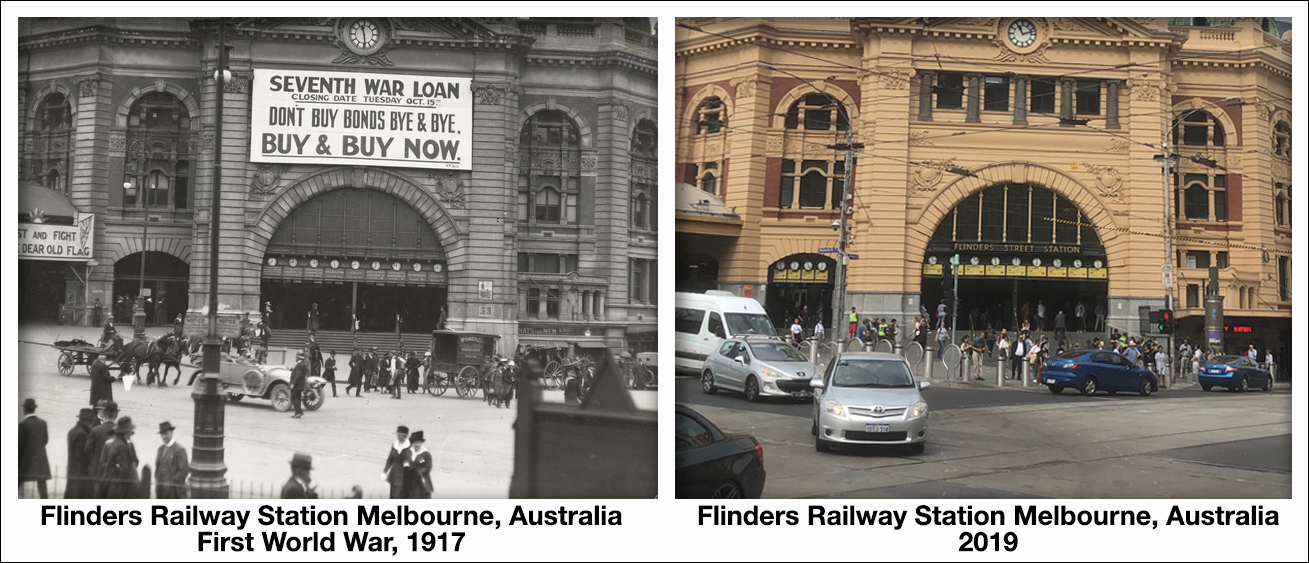
 History Then and Now